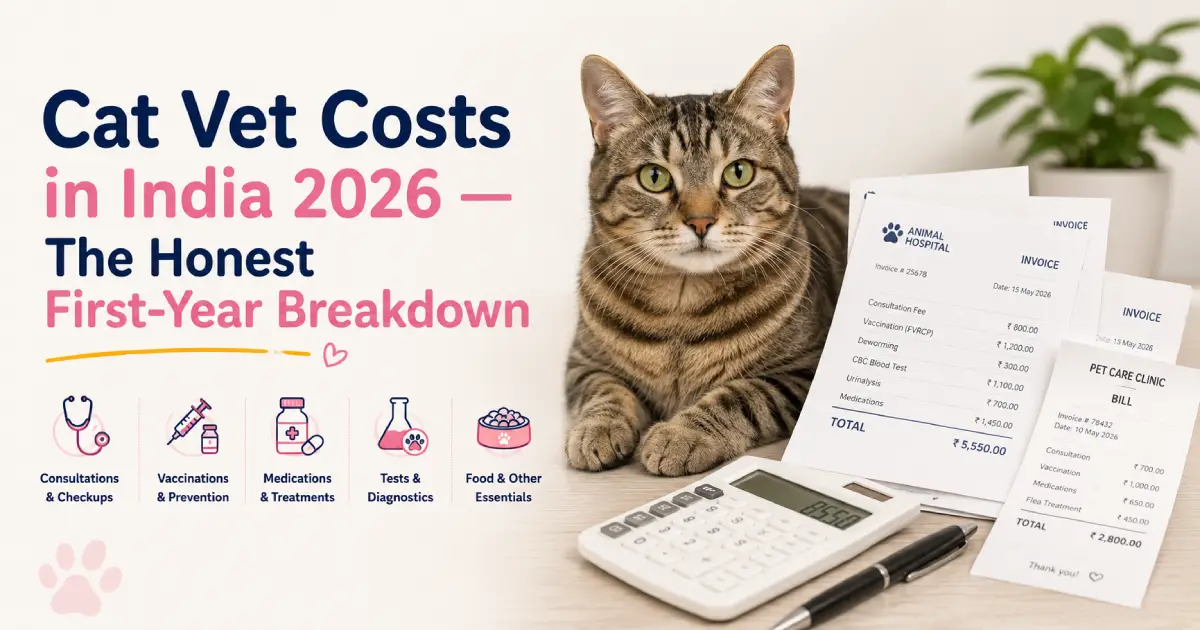
Bringing home a cat is exciting, but one of the biggest surprises for first-time cat parents is veterinary expenses. While cats are generally lower maintenance than many other pets, routine healthcare is essential for a long, healthy life. From vaccinations and deworming to annual health checks and unexpected medical emergencies. Understanding these costs early can help you plan better and avoid financial stress later and so this blog debriefs the Cat Vet Costs in India along with the Honest First-Year Breakdown!
Whether you’re adopting your first kitten or budgeting for a new feline family member, this guide will honestly help you understand exactly what to expect and how to give your cat the care they deserve without any surprises. In this guide, we break down the real first-year veterinary costs for cats across India, including city-wise price differences, mandatory vaccinations, spaying and neutering expenses, routine check-ups, and the common medical costs every cat parent should be prepared for in 2026.
First-year cat ownership in India costs approximately ₹5,000–10,000 in veterinary expenses including vaccinations, deworming, and spaying or neutering. Subsequent healthy years cost approximately ₹2,500–4,000. Vet costs vary significantly by city Mumbai and Delhi run 30–50% higher than Ahmedabad, Pune, or Surat.
The number one reason Indian cat parents delay vet visits is not indifference, it is fear of an unknown bill. This guide removes the unknown.
The complete first-year vet cost breakdown
| Service |
Metro cities (Mumbai/Delhi/Bangalore) |
Tier 2 cities (Ahmedabad/Pune/Surat) |
Frequency |
| Initial health check |
₹500–800 |
₹300–500 |
Once |
| FVRCP vaccination (3 doses) |
₹1,200–2,000 |
₹800–1,400 |
Year 1 only |
| Rabies vaccination |
₹400–600 |
₹300–450 |
Annual |
| Deworming (4x per year) |
₹600–900 |
₹400–700 |
Quarterly |
| Flea/tick prevention |
₹1,200–2,400 |
₹800–1,800 |
Monthly |
| Spaying (female) |
₹4,000–8,000 |
₹2,500–5,000 |
Once |
| Neutering (male) |
₹2,500–5,000 |
₹1,500–3,000 |
Once |
| Annual health check (year 2+) |
₹600–1,000 |
₹400–700 |
Annual |
| Routine illness visit |
₹500–900 |
₹300–600 |
As needed |
Metro cities: ₹8,000–14,000 (including spaying/neutering) Tier 2 cities: ₹5,500–10,000 (including spaying/neutering) Subsequent healthy years: ₹2,500–5,000 annually Note: These are private clinic rates. Government veterinary hospitals offer subsidised services at significantly lower rates worth researching in your city.
The vaccination schedule for cats in India. What, When, and Why?
Core vaccines are non-negotiable
FVRCP (Feline Viral Rhinotracheitis, Calicivirus, Panleukopenia): This is equivalent to the MMR vaccine in humans. It protects against three serious and potentially fatal viral diseases. The schedule for kittens:
- First dose: 8 weeks of age
- Second dose: 12 weeks of age
- Third dose: 16 weeks (recommended in many protocols)
- First booster: 1 year after the last kitten dose
- Ongoing: Annual boosters for life
Rabies: Required by law in many Indian states and strongly recommended everywhere. Typically given at 12–16 weeks with an annual booster. Even strictly indoor cats should be vaccinated as cats can escape, and exposure from bats inside buildings is a documented risk.
Optional vaccines worth discussing with your vet
- FeLV (Feline Leukaemia Virus): Recommended if your cat has any outdoor access or contact with unknown cats. Transmitted through saliva and close contact.
- FIV (Feline Immunodeficiency Virus): No approved vaccine currently available in India. Prevention through keeping cats indoor and preventing fights.
Deworming! The schedule most Indian cat parents skip
Intestinal parasites are extremely common in Indian cats, particularly in cats adopted from the street, shelters, or breeders with suboptimal hygiene. Roundworms, tapeworms, and hookworms can cause significant health issues and are zoonotic which are transmissible to humans.
The recommended deworming schedule for Indian cats:
- Kittens: Every 2 weeks from 2 weeks of age until 12 weeks, then monthly until 6 months
- Adult cats (indoor only): Every 3 months
- Adult cats with outdoor access: Every 6–8 weeks
Dewormers available in India include Drontal Cat (praziquantel + pyrantel), widely available at vet clinics and pet stores. Cost per dose: approximately ₹80–150 at a vet, lower for over-the-counter products.
Spaying and neutering and why it is worth the upfront cost
Spaying (females) and neutering (males) is the single most impactful health decision for your cat’s long-term wellbeing and one of the most cost-effective in the long run.
For female cats we have spaying
- Eliminates pyometra risk: A life-threatening uterine infection that affects unspayed females. Emergency surgery costs ₹15,000–30,000. Spaying at ₹2,500–5,000 eliminates this risk entirely.
- Dramatically reduces mammary cancer risk: Spaying before the first heat cycle reduces mammary tumour risk by approximately 91%. After the first heat, protection reduces but remains significant.
- Eliminates heat cycles: A cat in heat vocalises continuously, attempts to escape, and is highly stressed. Spaying removes this entirely.
For male cats, it’s neutering
- Eliminates testicular cancer: Complete prevention.
- Reduces spraying behaviour: Unneutered males spray urine to mark territory, a smell that is extremely difficult to remove from Indian apartment walls and furniture.
- Reduces roaming and fighting: Male cats that fight are at higher risk of FIV and FeLV transmission.
Recommended timing: 5–6 months of age for both males and females, before the first heat cycle in females. Some vets recommend as early as 4 months, discuss with your specific vet.
How to reduce vet costs without compromising care?
- Preventive care is cheaper than treatment: Vaccinations, deworming, and wet food to prevent urinary disease all cost significantly less than treating the conditions they prevent.
- Government veterinary hospitals: Available in every Indian city. Services are subsidised and often free for basic care. Quality varies significantly are worth visiting first before an emergency.
- Veterinary colleges: Teaching hospitals attached to veterinary colleges in cities like Anand (Gujarat), Mumbai, and Bangalore offer high-quality care at reduced rates supervised by faculty veterinarians.
- Build a relationship with one vet: A vet who knows your cat’s history makes better diagnostic decisions and is less likely to over-investigate. Continuity of care reduces both cost and stress.
- Along with this, Here’s a Must know blog before getting one – https://justcatsshop.com/5-things-every-first-time-cat-parent-in-india-must-know/