India’s pet care market is growing, yet most first-time cat parents receive no structured guidance on cat care before bringing a cat home. The information available online is overwhelmingly written for Western contexts: different foods, different vet systems, different apartments, different climates. This guide is different. Everything here is written for Indian homes, Indian products, and the real experience of being a new cat parent in India in 2026.
Pet Parents often gets confused when it come to underestimating daily care requirements, feeding the wrong food, misreading first-week behaviour as personality, not planning for vet costs, and missing hidden household hazards. These are the five things every First-Time Cat Parent in India Must Know, that come up most consistently when experienced Indian cat parents are asked:
What do you wish someone had told you before you got a cat?
1. Cats are not low-maintenance. They are just different-maintenance.
This is the most widespread misconception about cats and the one that causes the most shock in the first few weeks of cat ownership. Cats are sold to new parents as the easy pet: independent, self-sufficient, happy to be left alone. And compared to dogs, they are.
But low-maintenance is not the same as no-maintenance. The difference is not in quantity of care, it is in type. A dog needs walks. A cat needs environmental enrichment, mental stimulation, and social connection that is subtle but real. Miss these needs and you will not see an obvious sign of distress the way you would with a dog. You will see a cat who stops eating, starts overgrooming, or develops a stress-related illness.
What ‘low maintenance’ actually means for a cat?
A cat will not die if you skip a walk. They will not destroy furniture because they did not get exercise. But they will suffer quietly if the following are neglected:
- Daily play: Even 10–15 minutes of active play with a feather wand or laser pointer daily is important for an indoor cat’s mental and physical health. A cat who never plays becomes bored, anxious, and prone to stress-related illness.
- Social connection: Cats are not as solitary as their reputation suggests. Most domestic cats want interaction, proximity, and acknowledgement from their owners. A cat left completely alone for 10–12 hours daily without environmental enrichment will show signs of stress.
- Grooming: Short-haired cats manage most of their grooming independently. Long-haired cats like Persians, require regular brushing to prevent mats and hairballs.
- Litter box maintenance: This is daily, non-negotiable. A dirty litter box leads to health problems and behaviour issues.
2. Most cat food sold in India is imported, and there is a better option
Walk into any pet store or open Blinkit and search for cat food. The brands you will find first are Whiskas (made by Mars, distributed from Thailand and other countries), Royal Canin (French brand, manufactured globally), Me-O (Thai brand), and Felix (Nestlé Purina, imported). The dominant cat food brands in India are almost entirely foreign. This matters for a specific reason: imported cat food carries import duties, distributor margins, and logistics costs that inflate the MRP significantly. You are paying for the journey, not just the food. A ₹50 pouch of imported cat food has a meaningful portion of that cost allocated to getting it from overseas to your shelf.
Why the origin of cat food matters
It is not just about price. Three practical reasons why locally made cat food has advantages for Indian cat parents:
- Freshness: A shorter supply chain means less time between production and your cat’s bowl. Imported food, particularly wet food, travels longer before it reaches Indian retail often spending weeks in transit and warehouse storage.
- Price parity with actual value: When you buy a locally made cat food at ₹50, you are paying for the food not the shipping. The budget goes to ingredients and quality rather than logistics.
What to look for on a cat food label?
Most Indian cat parents buy food based on brand recognition alone. Learning to read a label is one of the most valuable things a new cat parent can do:
- First ingredient: Should be a named protein chicken, fish, lamb. Not ‘meat by-products’, not ‘cereals’, not ‘derivatives’. The first ingredient is the largest by weight.
- Moisture content: Wet food typically has 70–80% moisture. This is not dilution, it is hydration your cat needs. Cats have a low natural thirst drive and get most of their water from prey in the wild. Wet food mimics this.
- Taurine: An essential amino acid that cats cannot produce themselves. Must be present in any complete cat food. Deficiency causes heart disease and blindness. Any reputable brand includes it.
- ‘Complete and balanced’: This phrase on a label means the food meets nutritional standards for cats as a sole diet. Complementary foods require additional nutrition sources.
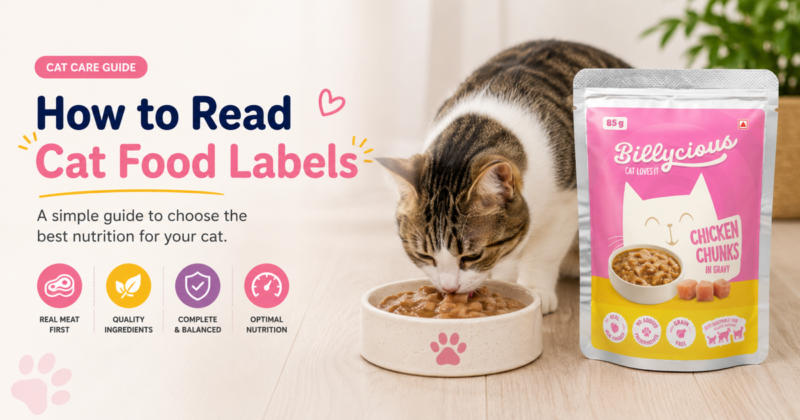
- One of the most accurate brands that depict these following is Billycious! It is an Made in india, for Indian cats brand wet food at ₹50 per 85g pouch. Find Billycious here.
Wet food vs dry food. What Indian vets actually say?
Most Indian vets recommend a mixed diet – wet food as the primary meal (especially for indoor cats) and dry food as a supplement or for dental reasons. The reason: cats have a low thirst drive and are prone to urinary disease when chronically mildly dehydrated. Wet food provides hydration that dry food simply cannot. A cat eating only dry kibble, especially in India’s hot climate, is at higher urinary health risk than one with regular wet food in their diet
3. Your cat’s behaviour in the first week is not their personality
This is the thing that causes the most panic and the most premature returns of cats to shelters or breeders. A new cat parent brings a cat home, and for the first 3–7 days the cat hides under the bed, refuses food, hisses when approached, and generally behaves as though they would rather be anywhere else. The reality is this is textbook normal settling behaviour, and it has nothing to do with the cat’s personality, their feelings about you, or their future relationship with you. It is a stress response to a complete sensory overload of new smells, sounds, people, and spaces.
Cats are territorial animals. Their sense of safety is rooted in knowing their environment. When you bring a cat home regardless of age, breed, or how sociable they are, you have removed them from every familiar scent, sound, and spatial reference point they had. Their nervous system registers this as a threat.
Hiding is not rejection. It is self-regulation. The cat is giving themselves space to process the new environment at their own pace. What you should do during this phase:
- Do not force interaction: Do not drag the cat out from under the bed. Do not pick them up repeatedly. This extends the settling period significantly.
- Sit near them quietly: Presence without pressure. Sit on the floor near where they are hiding. Read, work, or watch something. Let them observe you at a safe distance.
- Place food and water nearby: If they are under the bed, put a small bowl of wet food near the bed rather than forcing them to cross the room. Once they associate your presence with something positive like food, the approach distance shortens naturally.
- Use Feliway or a similar feline pheromone diffuser: Available in Indian pet stores and online. These synthetic calming pheromones measurably reduce settling time for new cats.
4. Vet costs in India are manageable, if you plan for them!
One of the most common reasons Indian cat parents delay or avoid vet visits is uncertainty about cost. The fear of an unknown bill is worse than the actual bill in almost every case. Here is the honest, realistic breakdown of what cat ownership costs in terms of veterinary care in India, so you can plan for it rather than be surprised by it.
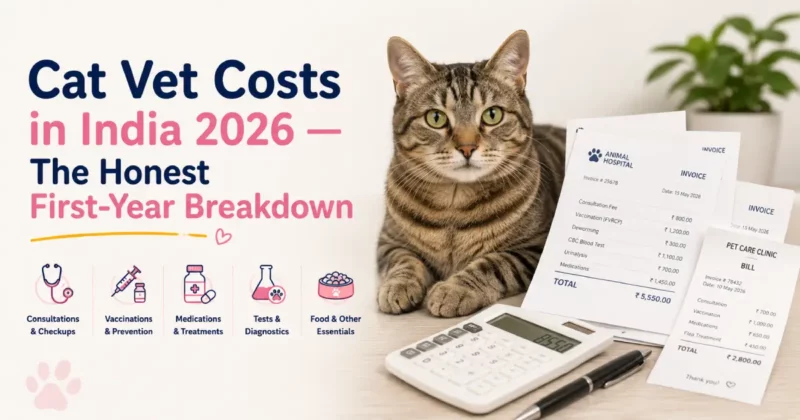
First-year vet costs for a cat in India (realistic breakdown)
| Item |
Approximate cost |
Frequency |
| Initial health check |
₹300–600 |
Once on adoption |
| Core vaccinations (FVRCP) |
₹800–1,500 |
Annual after first year |
| Rabies vaccination |
₹300–500 |
Annual |
| Deworming |
₹100–200 |
Every 3 months |
| Anti-flea/tick treatment |
₹200–400 |
Monthly or as needed |
| Spaying (female) / neutering (male) |
₹2,000–6,000 |
Once, at 5–6 months |
| Routine illness visit |
₹400–800 |
As needed |
| Annual health check |
₹400–700 |
Yearly |
First-year total (with spaying/neutering): approximately ₹5,000–10,000 depending on city and clinic. Subsequent years without major illness: approximately ₹2,500–4,000.
City variation is significant: Vet costs in Mumbai and Delhi tend to be 30–50% higher than in Ahmedabad, Pune, or Surat. Government veterinary hospitals offer significantly subsidised rates but may have limited appointment availability.
5. Household hazards specific to Indian apartments
- Open washing machines: Cats are drawn to warm, enclosed spaces. Always check before starting a wash cycle, this sounds extreme until you hear the stories.
- Balcony railings: High-rise cats are at risk of falls, the ‘high-rise syndrome’ where cats fall from significant heights. Install balcony nets if your cat has balcony access. These are available affordably from most hardware stores in Indian cities.
- Ceiling fans: Cats can and do jump at ceiling fans. Always turn off fans before active play sessions.
- Gas stove: Cats walk across surfaces. A cat walking across an unlit gas burner and then onto a lit one is a real risk. Never leave a cat unsupervised in a kitchen with an active stove.
- Rubber bands and threads: Indian homes tend to have rubber bands, threads, and small fibres accessible all of which are swallowing hazards for cats. Ingested thread can wrap around intestines and cause a surgical emergency.
- Phenyl and floor cleaners: Many Indian floor cleaning products contain phenols, which are acutely toxic to cats who walk across cleaned floors and then groom their paws. Use cat-safe cleaning products, or ensure floors are fully dry and ventilated before allowing cat access.
Nobody gets everything right in the first week with a new cat. The cats who thrive are not the ones whose parents knew everything from day one, they are the ones whose parents paid attention, stayed curious, and kept adjusting. The five things above are not meant to be overwhelming. They are meant to be reassuring: the most common mistakes are all avoidable with a small amount of the right information at the right time.
You are reading this, which means you are already ahead of most first-time cat parents. If you are at the beginning of your cat parent journey and based in India, JustCats is here to help, from the right food at the right price to a team in-store who actually understands cats.
Visit your nearest Justcats or JustDogs store, take our first-time cat parent quiz, or explore the JustCats blog for guides on everything from nutrition to litter to behaviour.